Tuesday, February 26, 2013

Google Glass: A Pathbreaking Innovation Which Can Disrupt Numerous Industries

Google (GOOG) recently unveiled details about the much anticipated Google Glass. The "explorer" version of this futuristic wearable computing product will be handed out through a contest to a limited number of individuals for $1500 apiece. The product is expected to be released to the mass market in early 2014. You can check out the latest teaser commercial here which I found to be very effective in creating a strong buzz. The commercial is already viral less than one week after its launch. For readers who are slightly late to the Google Glass party, I would recommend reading this review which has pretty much discussed every strength and weakness of this device.
(click to enlarge)
I first saw the introductory video about Google Glass sometime in the middle of 2012 and thought to myself that this may well be the next seminal innovation in the field of communication technology. When Apple (AAPL) introduced iPhone to the world in the year 2007, you did not have to be an industry guru to predict than this device is going to set the paradigms for the embryonic smartphone industry. The most commercially successful innovations in this fiercely competitive industry have not necessarily been cutting edge ultra futuristic innovations. They have been modifications of existing technology in a way that made those technologies more accessible or more user-friendly.
Users of early computers were managing well without the modern Operating System or the mouse. However, these seemingly banal innovations catapulted computing from being an esoteric activity to a ubiquitous one. Mankind seemed perfectly content with the vast land-line phone networks until cellular phone technology made communication much more accessible and convenient. Smartphones were already popular when the iPhone was launched. However, the latter abandoned physical key board and made the interface much more interactive by deploying motion sensors. These apparently minor innovations helped Apple earn more money than most sovereign nations.
I consider Google Glass in the same league of innovations as it brings regular activities closer to our senses and makes those activities much easier and faster to execute. What would you prefer? Saying "OK Glass…Take a photo" or taking out your phone, enabling the camera, pointing and shooting? Would you like running into the room to fetch your video camera to record the first steps of your daughter or would you prefer saying "OK Glass. Record this"?
It is important to note that the project Glass is still in its infancy as it does not have its own cellular radio. Users will need to connect it to a Wi-Fi network or tether it to their smartphones. No wonder then that Google recently endorsed the latest proposal by the FCC to make the entire U.S. Wi-Fi enabled. This endorsement is not surprising since the success of most of Google's upcoming innovations such as Glass, Chromebook etc. are almost entirely dependent on access to internet. The possibilities of further development on Google Glass are limitless and this product may disrupt numerous industries. The following industries seem most vulnerable to the Glass.
GPS Industry: In my opinion, conventional GPS will be the first casualty of the Glass. Drivers would much rather prefer navigating through their Glass rather than the unwieldy device which they need to stick to their windshields. Additionally, unlike conventional GPS which are vulnerable to burglary by car break in, Glass will seldom be left in the car after the drive. It appeared from the latest commercial that the Google Glass navigation is fairly superior and much more interactive than the conventional GPS. I do not anticipate a total annihilation of the likes of Garmin (GRMN) and Tom-Tom. However, there is a strong likelihood that the Glass will do to these firms what smartphones did to the "point and shoot" camera market.
Camcorder Industry: I agree that this one is a stretch but the video camera mounted on the glass can be exactly what the war journalists or movie makers of certain genres need. There were numerous footages in the commercial where the video recording was performed in less than ideal situations (Girl on the rollercoaster, Person running at an airport, Sky diving, Gymnastics etc.) but the footages seemed remarkably clear and crisp. Being able to record such events without holding a camera and having the ability to relay these recordings live on Google's network is a significant improvement to how videos are made and shared today.
Smartphone Industry: As of now, the Glass is aimed at existing smartphone users. However, making a phone call using Google voice or other VOIP services should not be difficult if Internet access is available. I agree that in its present shape, the Glass is more an accessory than a potential competitor to smartphones. Moreover, now that Google is beginning to make money from the smartphone market, it would be dense for them to disrupt the market. Nevertheless, I do not consider remote the possibility of the Glass to disrupt smartphone market sometime in the future. With further technological advances, it may be viable to install the phone hardware/cellular radio on the Glass without making it too heavy or unwieldy.
Recently a research firm raised the price target of GOOG to $1000 which set the investment community abuzz. Many commentators reckoned this was an ominous sign as AAPL's precipitous decline came soon after its price target was increased to $1000. However, I tend to disagree with such arguments. Apple and Google are two very different companies with very different visions and corporate cultures. While Apple's CEO is preoccupied assuaging an army of rambunctious shareholders, Google's innovation machinery is running at full speed. Tim Cook's single biggest achievement (if he could pull this) as Apple's CEO will be building a consensus around the future of Apple's cash hoard. Such pressure and negative scrutiny hardly nurture an environment of innovation. On the contrary, both Larry Page and Sergey Brin are very much involved in the day to day business of Google. In fact, Sergey Brin has been personally involved in the development and testing of Google Glass which makes me all the more confident about the success of this product. Moreover, Google's Chromebook is all set to destroy Microsoft's (MSFT) last-held bastion of Operating Systems. Manufacturers such as Acer are already badmouthing Windows 8 and raving about Google's Chrome OS. Chromebook has received rave reviews and is the best selling laptop on Amazon. Google's much criticized acquisition of Motorola is all set to pay rich dividends through the launch of Chromebook pixel and X phone.
In conclusion, the Google Glass is a very promising product that will come out from Google's highly secretive division X. As per industry insiders, Google's best brains (including Sergey Brin) have been working on this project and so far it looks like they have nailed this one. This product has the potential to redefine the smart devices industry and can relegate many existing technologies to obscurity. While I have no intention to enter the debate on the price target of GOOG, I am fairly confident of the long-term prospect of this company.

Monday, October 22, 2012

Recycled Cardboard Bicycles For $9?


Cardboard Bicycle - Environment News - Israel
They are made of recycled cardboard, can withstand water and humidity, cost nearly nothing – and might change the concept of green vehicle. Izhar Gafni is a Kibbutz resident, who decided to prove to his fellow engineers that he could make a bicycle at nearly no cost.
“They said it was impossible”
Izhar Gafni, originally from Kibbutz Bror Hayil in the Negev, took the most popular and widely sold vehicle in the community and decided to turn it into an entirely green private venture.
Gafni’s bicycle redefines the idea of green transportation in every way, being environmentally friendly from early stages of production all the way through creation of the final product. The bicycles are made out of recycled and used cardboard.
“I really love bicycles, and when I worked in the United States I inquired in California to see if anyone has already thought of the concept of a cardboard bicycle. To my delight, I only discovered similar concepts based on bamboo. But when I started asking engineers about the possibility of producing a cardboard bicycle, I was sent away and told that the realization of my idea is impossible. One day I was watching a documentary about the production of the first jumbo jet – and an engineer on the team had said that when everyone tells him that what he is doing is impossible – it makes it even clearer to him that he is progressing in the right direction. That saying motivated me to experiment with different materials on cardboard, to find what produces the desired strength and durability.”
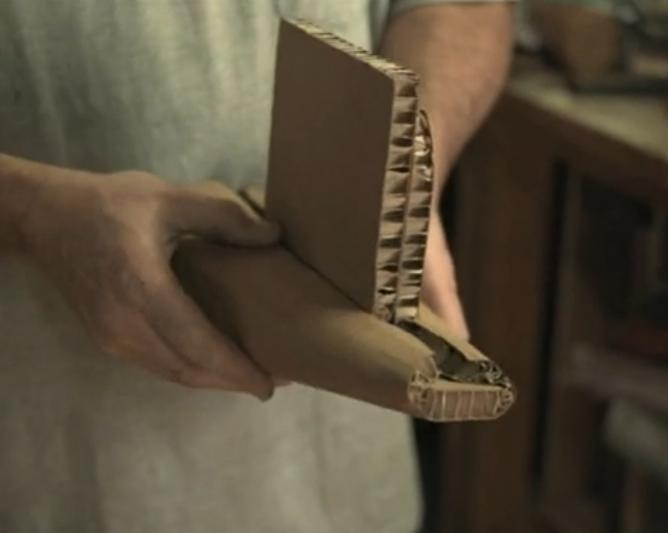
Gafni, who decided to take this on as a personal project, conducted several experiments to see how he could make the recycled cardboard strong enough to carry a person weighing up to 140 kilograms. Finally, he created several prototypes that were fairly durable but too bulky.
Cardboard4 300x239 Recycled Cardboard Bicycles For $9?
Gafni in production stages
“My first prototypes looked like delivery boxes on wheels. They were hefty and it didn’t take much imagination to see that they were made of cardboard. When I met with investors it was difficult to explain my ultimate vision with the bikes, which led me to understand that I need to devote more time towards developing a more comfortable design, lighter and more impressive.”
Judging based on the prototypes leaning on the wall during the interview with Gafni, it seems that his hard work paid off. The prototype in the room was impressive. It was hard to believe there was any relationship between that bicycle and cardboard. The bicycle is coated with a strong solid layer of brown and white material, making the finished product look like it is made of hard lightweight plastic.
There’s nothing to steal
In Tel Aviv, for example, where all but a few cyclists have had their bikes stolen at some point, low-cost bikes are all the more attractive and also weaken the sting of a steal. If the bicycle costs less than the lock required to keep it safe, the appeal and potential profit from stealing a bicycle are significantly reduced.
Additionally, those who decide to add a removable engine to make the bicycle electric can take the engine with them after parking it. The engine is the most expensive component and the bicycle itself is no longer worth the thief’s trouble. Thus, Gafni’s low-cost bicycle can be an especially attractive city vehicle.

“I really love bicycles, and when I worked in the United States I inquired in California to see if anyone has already thought of the concept of a cardboard bicycle. To my delight, I only discovered similar concepts based on bamboo. But when I started asking engineers about the possibility of producing a cardboard bicycle, I was sent away and told that the realization of my idea is impossible. One day I was watching a documentary about the production of the first jumbo jet – and an engineer on the team had said that when everyone tells him that what he is doing is impossible – it makes it even clearer to him that he is progressing in the right direction. That saying motivated me to experiment with different materials on cardboard, to find what produces the desired strength and durability.”

Wednesday, April 25, 2012

Wednesday, March 21, 2012

Israeli device takes the thirst out of war zones


Supplying water in battle zones is expensive and sometimes deadly. Armies around the world spend millions of dollars transporting water to thirsty troops on the front lines, often under extremely dangerous conditions

Saturday, March 3, 2012

Micro Luggage - luggage that moves you!


Micro Luggage is luggage that moves you! Micro spent 3 years developing Micro Luggage in cooperation with Samsonite. A lightweight, hard shell, cabin-sized case with a built-in kickboard scooter. It can be used as a trolley or as a scooter with a case. Fly past the other passengers and always make it to the gate on time.

Saturday, February 25, 2012

Warby Parker: “Why Should A Pair Of Glasses Cost More Than An iPhone?”


If you’ve ever shopped for a pair of prescription glasses, you’ve probably seen first hand how expensive a set can be. Warby Parker’s co-founders are right there with you.

Both fed-up and puzzled over paying hundreds of dollars for a product that’s been around for hundreds of years, the Warby Parker team is shaking up the eyewear industry by selling prescription glasses online, at a price tag of just $95 a pair.

Having crafted their plan during business school, the foursome launched the company two years ago this month. Three weeks after the initial pair went on sale, co-founder, Neil Blumenthal says Warby Parker hit its sales targets for the entire year and adds “we sold out of our top 15 styles in four weeks”. The company has since ramped up to 60-employees.

Two of Warby Parker’s co-founders, David Gilboa and Neil Blumenthal recently stopped by TCTV to give Founder Stories host, Chris Dixon the backstory on how the company got started.

As lifelong eyeglass wearers, Gilboa tells Dixon the group couldn’t understand why “glasses cost more than an iPhone.” After doing some research they realized “there’s a handful of companies that control the entire supply chain.” Not content to roll with the status quo, Gilboa says the team set out to change the landscape by creating “our own brand of glasses …. so we could sell the same product that normally costs $500 for $95.”

However, because their product was only available online, the team had to figure out a way for customers to try on the frames. Blumenthal says their solution was to create a “first of its kind” program “in the US where you select 5 frames, we ship it to you free of cost and you have 5 days to try them on at home, with no obligation to buy.”

Gilboa adds that this process enables customers to receive feedback from people “they trust” (versus paid sales staffers) and as an added benefit, Warby Parker receives “millions of free impressions” from users who post tryout pictures to their social networking sites.

As the interview unfolds, Gilboa and Blumenthal share plenty more insights, so sure to watch the entire video to hear more.

Past episodes for Founder Stories featuring Jeff Clavier, Cyrus Massoumi, Stephen Kaufer, Mayor Bloomberg and many other leaders are here.

Thursday, December 29, 2011

Solar paint could transform houses into giant electricity generators

t's common to see houses with solar panels on the roof harvesting energy to power household electricity, and if lucky the electrical grid. Now, a team from the University of Notre Dame is swinging back around on the idea of solar paint, and using semi-conducting particles to produce energy. This paint would be cheap enough to cover your entire house and turn it into a massive solar powered generator.

The goal was to find a way to move beyond silicon based solar technology. The team centered in on nano-sized particles of titanium dioxide, coated with either cadmium sulfide or cadmium selenide. The particles were mixed with a water-alcohol base to create a paste.

When the paste was brushed onto a transparent conducting material and exposed to light it created electricity.

While this is a huge stride in re-envisioning solar power there are still some hurdles. According to Prashant Kamat, John A. Zahm Professor of Science in Chemistry and Biochemistry and an investigator in Notre Dame's Center for Nano Science and Technology (NDnano), which is leading the research, "The best light-to-energy conversion efficiency we've reached so far is 1 percent, which is well behind the usual 10 to 15 percent efficiency of commercial silicon solar cells."

"But this paint can be made cheaply and in large quantities. If we can improve the efficiency somewhat, we may be able to make a real difference in meeting energy needs in the future," he added.

The team has christened the new paint "Sun-Believable and in addition to looking at increasing the efficiency of the product they will also measure stability. Their work on the solar paint has been published in the research journal ACS Nano.

While it is still early days, it does sound like the paint has a bright future.

New Car Engine Sends Shock Waves Through Auto Industry


Despite shifting into higher gear within the consumer's green conscience, hybrid vehicles are still tethered to the gas pump via a fuel-thirsty 100-year-old invention: the internal combustion engine.

However, researchers at Michigan State University have built a prototype gasoline engine that requires no transmission, crankshaft, pistons, valves, fuel compression, cooling systems or fluids. Their so-called Wave Disk Generator could greatly improve the efficiency of gas-electric hybrid automobiles and potentially decrease auto emissions up to 90 percent when compared with conventional combustion engines.

The engine has a rotor that's equipped with wave-like channels that trap and mix oxygen and fuel as the rotor spins. These central inlets are blocked off, building pressure within the chamber, causing a shock wave that ignites the compressed air and fuel to transmit energy.

The Wave Disk Generator uses 60 percent of its fuel for propulsion; standard car engines use just 15 percent. As a result, the generator is 3.5 times more fuel efficient than typical combustion engines.

Researchers estimate the new model could shave almost 1,000 pounds off a car's weight currently taken up by conventional engine systems.

Last week, the prototype was presented to the energy division of the Advanced Research Projects Agency, which is backing the Michigan State University Engine Research Laboratory with $2.5 million in funding.

Michigan State's team of engineers hope to have a car-sized 25-kilowatt version of the prototype ready by the end of the year.

Monday, October 24, 2011

New Israeli invention - intercepts antiaircraft missile!

slamists are rioting, pirating, terrorizing and destroying our world, while Israelis are innovatively protecting it!!!

Elbit "C Music" intercepts anti aircraft missile

Tuesday, June 7, 2011

MIT Figures Out a Way to Refuel Electric Cars with Liquid Fuel

By Adam Clark Estes Jun 06, 2011

A group of young MIT students have developed a new type of battery that runs on a rechargeable liquid fuel. The inventors call the fuel "Cambridge Crude," and if the technology makes it to market, refueling an electric car could be as easy as pulling up to a pump. The batteries are powered by semi-solid flow cells, an innovative architecture in which charged particles floating in a liquid electrolyte between two containers--one for storing energy and one for discharging energy. Separating out the functions and other innovations make the new battteries ten times as efficient as similar existing technology and cheaper to manufacture than lithium-ion batteries. In short, the new batteries make irrelevant the size and cost limitations that have kept this kind of technology out of electric cars to date. The MIT News Office reports:

The new design should make it possible to reduce the size and the cost of a complete battery system, including all of its structural support and connectors, to about half the current levels. That dramatic reduction could be the key to making electric vehicles fully competitive with conventional gas- or diesel-powered vehicles, the researchers say.

Another potential advantage is that in vehicle applications, such a system would permit the possibility of simply “refueling” the battery by pumping out the liquid slurry and pumping in a fresh, fully charged replacement, or by swapping out the tanks like tires at a pit stop, while still preserving the option of simply recharging the existing material when time permits.

According to supervising professor Yet-Ming Chiang, the group originally set out "to reinvent the rechargeable battery" and expects to have a fully operational prototype that could be manufactured for electric cars in the next 18 months.

Sunday, November 7, 2010

License to Print Money

by Robert X. Cringely
Photovoltaic solar cells have been part of renewable energy planning for as long as such planning has existed, with most of those solar cells made from crystalline silicon with energy conversion efficiencies above 20 percent. But crystalline cells are expensive and take a lot of energy to create, reducing their net energy contribution. Fortunately there are other types of solar cells including thin film, amorphous, plastic, and others. All of these are cheaper than crystalline cells though they also tend to have shorter working lives and lower efficiencies. We care about them, though, because organic plastic solar cells in particular offer the prospect of producing the cheapest electric power of all. That is if one of our Startup Tour companies — Solarmer Energy Inc. — meets its design goals. I think they will.

Solarmer is effectively a Chinese company operating in America. Located in Baldwin Park, CA, Solarmer’s management is entirely from Taiwan, though many U. S. nationals are employed at the company. Solarmer is well funded, has been operating for several years now, and is moving relentlessly toward the goal of creating very large plastic solar cells that are 10 percent efficient, have a 10-year service life, and can be manufactured for $0.50 per watt or less.

Crystalline solar cells last for 25 years or more, but plastic or polymer solar cells have traditionally operated for only 2-3 years. Through the use of special UV-resistant coatings, Solarmer is attacking this longevity issue, though since the cost of plastic cells is so much less than silicon, 10 years is good enough.

Solarmer is steadily pushing cell efficiency, too, with their current world record in excess of eight percent efficient. Their goal is 10 percent and I believe they will make it.

Solarmer’s target of $0.50 per watt is based on low material cost and especially on low cost of production. The capital cost for producing Solarmer plastic cells is almost nothing as you’ll read below.

Plastic solar cells are made with a roll-to-roll printing process that starts with a clear plastic substrate on which multiple photo-sensitive semiconducting layers are printed, followed by a clear coat. Solarmer has a pilot printing plant operating in a clean room at its facility, though the world record cells have to this point been mainly built by hand.

Solarmer didn’t invent plastic solar cells, nor are they the only manufacturer. Another company — Konarka Technologies Inc. — is already producing such cells that can be found in many products. Both companies make flexible plastic solar cells, but there is a significant difference in their manufacturing strategies that made one company more interesting to me than the other (both were nominated for the Startup Tour).

Konarka builds its plastic solar cells in a 250,000 square foot former Polaroid photographic film plant in New Bedford, MA. With total control of its own production Konarka is already selling product where Solarmer is not. Unlike Konarka’s Big Factory strategy, Solarmer says it intends to license its technology to commercial printers. The difference between printing Parade magazine for your Sunday paper or printing hundreds of thousands of plastic solar cells per day is the addition of an extra drying stage at the output end of the web printer.

That’s why Solarmer quietly works-away, relentlessly pushing its technology to produce a little more power for a lot less cost. Once the specs are where the company wants them to be, their process will be released to a magazine publishing industry that has been slowly dying, killed by a combination of economic recession and Internet publishing. Hundreds of web printers originally costing tens of millions each will be repurposed for inexpensive energy production at that target $0.50 per watt — not just grid-parity but a quarter the cost of power from coal.

Flexible plastic solar cells will go everywhere the sun shines, produced in long rolls, covering roofs and even windows (the cells can be made transparent). Efficiencies are lower, sure, but so will be the cost. Any structure can produce at least some of its own energy. And though the plastic cells will have only a 10-year life, that’s longer than a paint job lasts in Charleston.

It’s a strategy of ubiquitous good-enough solar power that I find very compelling as part of our energy future.

Saturday, August 21, 2010

CAR BANDAID JUMBO


CAR BANDAID JUMBO


Magnetic car bandage is the way to fix damages. Easy to apply and can be removed without damage to the car. Put it over dents, rust, or any surface that needs healing (or hiding). It's much cheaper than bringing your car in for repairs and sure to get a laugh from passersby. Magnet, 17 x 5".

now $6.98

Saturday, August 14, 2010

Sunday, July 4, 2010

Saturday, June 12, 2010

solution for Mexico Gulf Oil Spill Clean-up

The oil spill in the Gulf of Mexico has been tragic. To help clean up the mess, a team from the University of Pittsburgh have designed a new way to removing oil from water.

It’s made of cotton dipped in a polymer which lets water through but repels oil. Here is a video of it in action.

On a large scale spill such as the Gulf of Mexico, the team envisages making large troughs out of the material and scooping it along the surface of the water. Not only would it clean the water, but the oil collected can recovered and the filter reused.